Word Planet
- 4.7
- Rating
- 1.00M
- Installs
- Free
- Price
 Analysis by App-foxy
Word Planet is the kind of word game I open when I want something relaxing but still a little mentally demanding. It combines short word-search rounds with changing scenic backdrops, so the experience feels calmer than a competitive word puzzle while still giving me a reason to keep looking for one more answer. PlaySimple Games developed it as a free game for everyone, and its broad appeal is easy to understand: the basic idea is familiar, the controls are approachable, and a puzzle can fit into a spare moment.
After spending time with it, my impression is that the game works best as a gentle daily habit rather than as a serious vocabulary trainer. I enjoy the simple loop, especially when I am waiting for an appointment or winding down before bed. At the same time, players who want strict dictionary rules, fast competition, or completely unrestricted play may find its structure less satisfying. The important question is not whether it is polished enough to try; its average rating of 4.7 from around 43 thousand ratings suggests that many people enjoy it. The better question is whether this particular blend of scenery, progression, and word searching matches the way you like to play.
What the current version feels like to play
The current release is version 1.102.0, and that number tells me the game has been maintained through a long period rather than treated as a one-off puzzle experiment. I would not read a version number alone as proof that every part of the experience has changed dramatically, but it does fit the feeling of a mature mobile game: the central format is immediately understandable, while the surrounding presentation is designed to keep the routine from becoming completely flat.
You May Also Like

 Blood Strike: 2.5 Anniversary
Blood Strike’s Loadouts Turn Every Drop Into a Tactical Gamble
A close look at Blood Strike’s custom loadouts: how fast access to signature weapons reshapes its battle royale rhythm, rewards preparation, and narrows the gap between fights.

 Pandora - Music & Podcasts
Pandora’s Music Is Easy to Start, but Harder to Recover
Pandora’s strength is its low-effort path from a seed to a station. Its weak spot is how much confidence it asks you to place in connection, setup, and quiet recovery.

 8 Ball Pool
 Is Built on Rivalries, Rematches, and Routine
A close look at the rivalries, rematches, shared routines, and unanswered safety questions that turn a quick pool match into a persistent mobile community.

 Samsung Music
’s Quiet Strength Is Playing What You Already Own
Its reach comes less from spectacle than from dependable access to a personal library. That simplicity is both the app’s strongest retention engine and its ceiling.

 AccuWeather: Weather Radar
AccuWeather Review: A Quick, Clear Forecast for Everyday Decisions
For everyday plans, the best forecast is the one you can understand quickly. AccuWeather makes rain timing, radar, and local conditions easy to act on, with a few trade-offs.

 Hill Climb Racing
Why Hill Climb Racing Still Turns Crashes Into One More Run
A tiny car, a bumpy hill and one more upgrade: Hill Climb Racing keeps resurfacing because its simple chaos makes every near-miss feel personal.
More From Our News Desk



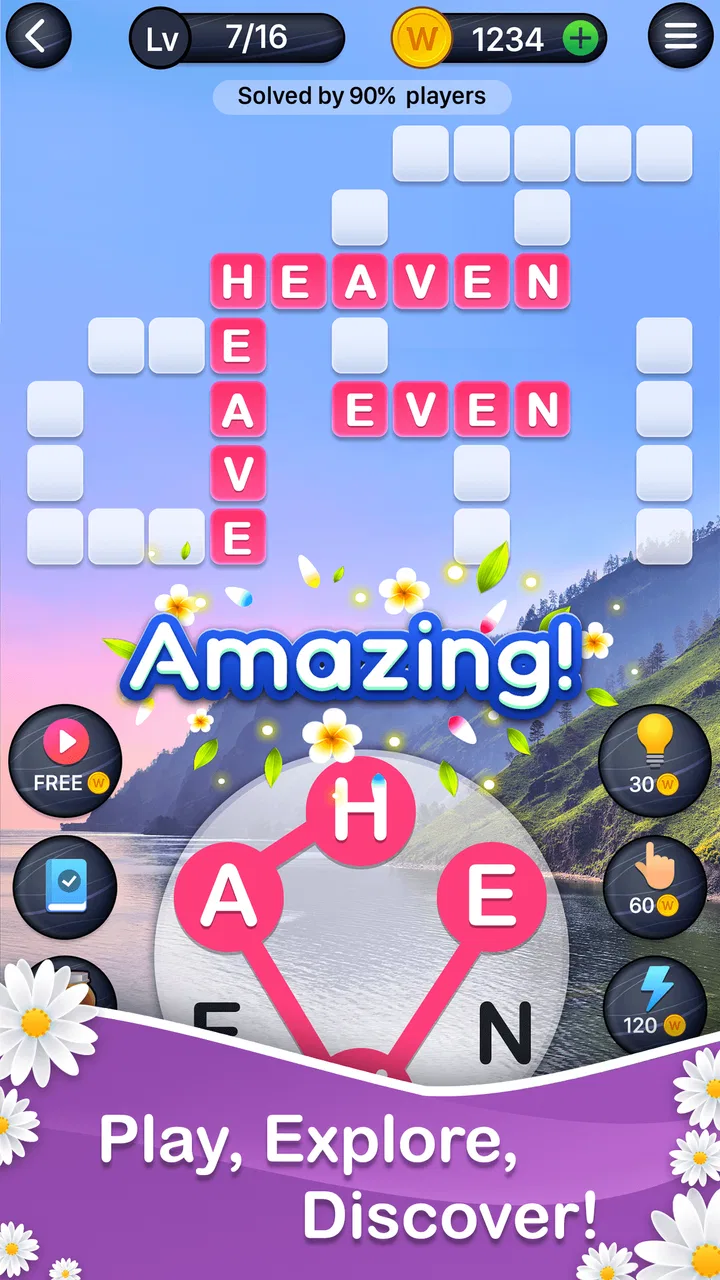
A typical session begins with a word puzzle that asks me to find answers from a limited collection of letters. I can work through obvious short words first, then look for less apparent combinations. That order matters. Solving the easy entries gives the board momentum, while the remaining spaces encourage me to reconsider letters I initially ignored. I like that the game can be played in a quiet, unhurried way instead of demanding rapid tapping.
The scenic setting is more than a decorative sentence in the store summary. It changes the mood of the activity. I do not approach a round with the same pressure I feel in a timed word challenge, because the visual presentation makes the game feel closer to a small journey through illustrated locations. For me, that makes it especially suitable for short breaks when I want concentration without intensity.
There is also a useful psychological rhythm in the way the puzzles are presented. A difficult board can feel manageable after I clear a few answers, and a simple board still gives me a reason to inspect the letters carefully. My practical tip is to avoid guessing randomly when I get stuck. I first scan for common endings, plural forms, and familiar letter pairs, then revisit the unused letters. This approach saves hints and makes the solving itself more rewarding.
Why the word format remains approachable
Word Planet does not require me to learn complicated controls or understand a large ruleset before playing. That makes it a comfortable recommendation for someone who enjoys crosswords, anagrams, or casual spelling puzzles but does not want the commitment of a long session. The game can also suit mixed-age households because its content rating is Everyone, although individual players will naturally differ in vocabulary and patience.
Its accessibility has a trade-off. The easier entry point means experienced word-game players may move through familiar puzzles without much resistance. I would not choose it as my only game if my main goal were to expand vocabulary systematically or measure myself against expert solvers. It is better at making word practice inviting than at turning every round into a demanding test.
How it compares with familiar alternatives
Compared with a daily guessing game, this is less about identifying one target answer and more about gradually clearing a collection of words. That gives me more playtime and a softer sense of failure, since one missed word does not define the whole session. Compared with a traditional crossword, it offers less clue-based deduction and more letter manipulation. If I enjoy interpreting definitions, I may prefer a crossword; if I like spotting combinations from a compact letter set, this format is more direct.
It also differs from competitive multiplayer word games. There is no need for me to react to another player’s speed or protect a winning streak in a live contest. That is a strength when I want a low-pressure activity, but a weakness when social rivalry is the main reason I play. In short, the game occupies the relaxed middle ground between a visual unwind and a conventional word puzzle.
How the experience has evolved and what that means for players
The release date of December 24, 2019 places Word Planet in the established era of mobile puzzle games rather than among brand-new experiments. Its continued presence, current version, and more than one million installs point to a product that has found a durable audience. I see that longevity as useful context: the game is not asking players to understand an unfinished concept, but it also should not be judged as though it were trying to reinvent word puzzles.
For existing users, a mature version can be reassuring because the familiar core is likely to remain easy to return to. I can leave the game for a while and come back without needing to relearn an elaborate system. That continuity is valuable in a casual title. The downside is that long-term players may notice the repetition more clearly than newcomers. Once the basic solving pattern becomes automatic, scenic changes and new puzzle progression have to do more of the work to maintain interest.
I would therefore judge updates by their effect on the daily routine rather than by the version label alone. A useful change is one that keeps navigation clear, makes returning to a puzzle painless, or gives the player a fresh reason to solve without undermining the relaxed pace. I would be cautious about expecting every update to transform the game. The evidence available in the current release supports a maintained word-puzzle experience, not a promise of a completely different genre.
One practical question many players have is whether they can enjoy it without spending money. The game is free to download and play, which makes trying it straightforward. It also includes in-app purchases ranging from $0.99 to $99.99 per item. I recommend treating optional purchases as a personal boundary before starting: if hints or progression tempt you when a puzzle becomes frustrating, decide in advance whether you are comfortable waiting, solving more patiently, or paying for convenience.
That payment structure affects how I use the game. I prefer to regard a difficult round as a pause rather than an obstacle that must be removed immediately. I close the puzzle, do something else, and return with a fresh view of the letters. This is not merely a money-saving habit; it often improves solving because I stop forcing the first pattern that comes to mind. Players who dislike any purchase prompts or who want a fully fixed-price experience should consider that friction before committing to regular play.
A realistic everyday routine
Imagine having ten minutes before a train arrives. A competitive game may feel too demanding, while a long story game is inconvenient to start. This is where I find the format useful. I can open a puzzle, solve several words, and stop without feeling that I abandoned a complicated mission. Later, I can return to the same kind of activity when I need a quiet break. The scenic presentation helps the session feel intentional rather than like empty screen time.
For a family member who enjoys spelling but becomes discouraged by strict timers, I would also consider it a good starting point. The player can focus on recognizing words and building confidence. I would not present it as a replacement for educational software, because casual discovery and structured instruction are different goals. Its value is in making repeated word searching pleasant enough to revisit.
A more advanced use is to turn each puzzle into a small vocabulary exercise. When I find a word I rarely use, I pause to think of a sentence containing it instead of tapping through immediately. I can also keep a short note of unfamiliar words and check their meanings later with a dictionary. That workflow adds learning value without pretending the game itself provides a formal lesson plan.
Where the current experience still has limits
The main limitation is repetition. The central action remains searching for words from letters, so players who need constant mechanical variety may lose interest. The scenery changes the atmosphere, but it does not automatically change how I solve a board. I find the game most enjoyable when I accept that consistency is part of its appeal rather than waiting for every stage to introduce a new rule.
Another limitation is that casual word games can disagree with personal expectations about acceptable answers. A player may see a possible combination and wonder why it is not recognized, while another may encounter an answer that feels unfamiliar. That kind of moment can interrupt the relaxing mood. My advice is to treat the puzzle’s word set as the game’s rulebook for that round, rather than assuming it will behave exactly like a dictionary, crossword editor, or language-learning tool.
The game is also not the best choice for people who want deep strategic planning. There can be satisfying choices about which letters to inspect and when to use assistance, but the experience is still built around accessible discovery. If I want a demanding long-form challenge, a cryptic crossword or a more competitive word title gives me more depth. If I want a calm, attractive puzzle I can pick up casually, this is where Word Planet makes more sense.
What I would watch as a returning player
When I revisit the game, I pay attention to whether the scenic progression continues to support the puzzle loop or starts to feel like a backdrop I no longer notice. I also watch how comfortably the game handles players who prefer to solve slowly. A relaxed word title should make patience feel like a valid play style, not a mistake that must be corrected with a purchase.
I would also look for signs that the developer, PlaySimple Games, keeps the experience welcoming for both new and returning players. Newcomers need a clear path into the format, while long-term users need enough variation in the journey to avoid feeling that every session is interchangeable. The strongest future direction would preserve the uncomplicated controls while giving experienced solvers reasons to examine puzzles more carefully.
For someone deciding whether to install it, the practical requirements are modest: the game supports devices running Android 8.0 or later, and it is available at no upfront cost. The install base of over one million shows that it is easy to find an audience, but popularity alone should not decide the purchase. I would install it if I wanted scenic, casual word searches and was comfortable with optional purchases. I would skip it if I wanted multiplayer competition, rigorous vocabulary study, or a puzzle format that changes fundamentally from one stage to the next.
My final view is positive, with the right expectations. Word Planet is not a replacement for every kind of word game, and its familiar loop can become repetitive for demanding players. Still, its calm presentation, approachable puzzles, and easy short-session structure make it a dependable choice for everyday downtime. I especially recommend it to someone who wants to exercise attention without turning relaxation into a contest. The best way to enjoy it is to treat each round as a small scenic break, not a race and not a test of linguistic perfection.
If that sounds like your style, Word Planet is worth trying as a free casual game from PlaySimple Games. Give it a few unhurried sessions before deciding whether the progression holds your attention. In my experience, its appeal comes less from a single spectacular feature than from the way familiar word searching, gentle visuals, and flexible pacing fit together. That combination will not satisfy everyone, but for the right player it is an easy game to return to.
FAQs for Word Planet
01What is Word Planet, and how does the game work?
Word Planet is a casual word puzzle game in which you form words from a group of available letters. Each completed puzzle usually unlocks new stages, destinations, or themed locations, giving the game a light travel-inspired progression system. The controls are simple: tap or swipe across letters to create words, while bonus words and extra challenges can provide additional rewards.
02Is Word Planet free to download and play?
Word Planet can generally be downloaded and played without an upfront purchase, making it accessible to most users. However, free versions may include advertising, optional in-app purchases, or paid items such as hints, coins, and ad removal. Before downloading, check the store listing for the current pricing details, supported payment options, and whether purchases can be restricted through your device settings.
03Does Word Planet require an internet connection?
Many of Word Planet’s basic puzzles may be playable without a constant internet connection, which is useful when traveling or using limited mobile data. Nevertheless, an internet connection may be needed for advertisements, cloud synchronization, updates, rewards, or certain special events. Offline availability can differ between Android and iOS versions, so it is best to test the game after installation.
04Is Word Planet suitable for children and beginners?
Word Planet is generally easy to understand because its main mechanic involves connecting or selecting letters to form words. It can be suitable for casual players, families, and beginners who enjoy vocabulary games, although the difficulty may increase as levels progress. Parents should review the game’s age rating, advertising content, and in-app purchase settings before allowing younger children to play.
05What should I know about hints, advertisements, and in-app purchases?
Word Planet may use hints or virtual currency to help players solve difficult puzzles, and these resources can often be earned through gameplay or obtained by watching advertisements. Optional purchases may provide additional coins, remove ads, or unlock other conveniences. You can usually continue playing without spending money, but managing notification, advertising, and purchase permissions is recommended for a smoother experience.
Pros
- Relaxing word puzzles suitable for short or extended play sessions.
- Simple controls make it accessible for players of different ages.
- Progression system provides a steady sense of achievement.
- Offline play is convenient when traveling or without mobile data.
- Vocabulary challenges can help improve spelling and word recognition.
Cons
- Some levels may feel repetitive after extended play.
- Hints and extra assistance may be limited without spending resources.
- Difficulty can vary noticeably between consecutive puzzles.
- Ads may interrupt gameplay
- depending on the app version.
- Players seeking competitive multiplayer may find the experience limited.

Word Planet
Gallery